This document contains information about the rules used to create Standard Names for use with Earth System Models. It describes the
- ESM Standard Name rules
- Standard Name qualifiers
- Other common standard name components
- Acronyms, abbreviations, and aliases
- Units
Standard names should be identical to those from the latest version of the Climate and Forecast (CF) metadata conventions unless an appropriate name does not exist in that standard, or the adoption of said names leads to inconsistencies in the naming convention.
When no suitable standard name exists in the CF conventions, the following guidelines should be followed for constructing a new name. The phrases in brackets are optional. The words in italic appear explicitly as stated, while the words in
this fontindicate other words or phrases to be substituted. The new standard name is constructed by joining the base standard name to the qualifiers using underscores.[
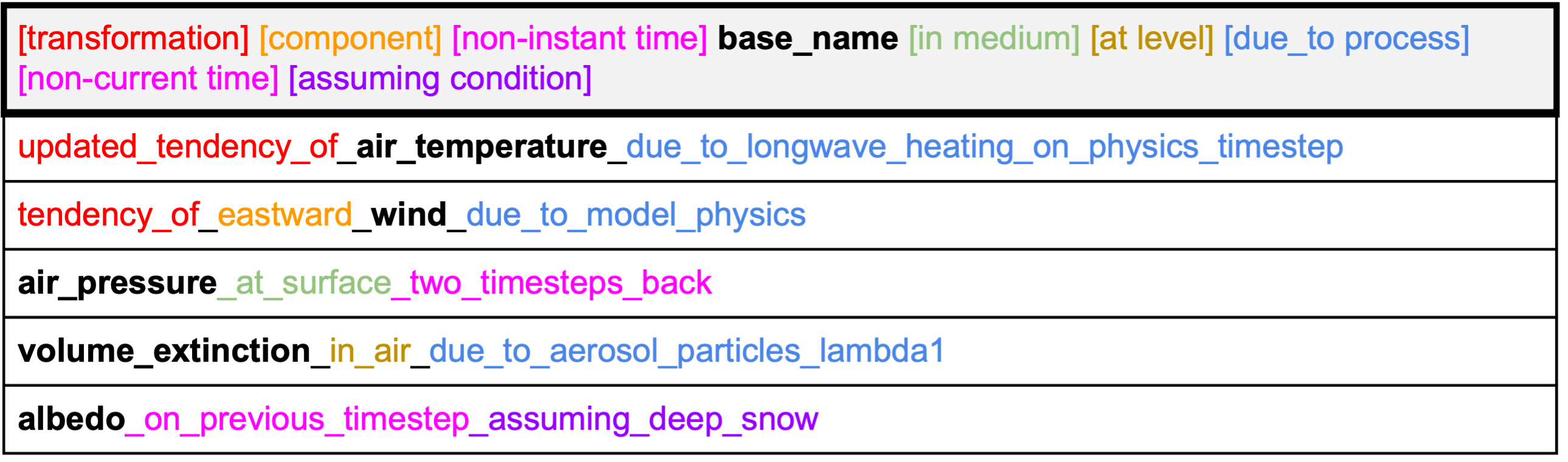
transformation] [component] [non-instant time] base_name [in/ofmedium] [atlevel] [due_toprocess] [non-current time] [assumingcondition]This construction was originally based on rules set forth in the CF guidelines, but have since evolved for better consistency and generality across a broader set of fields than was originally envisioned by the CF conventions. "
medium" should be specified when the variable in question is a substance or other quantity contained within some other medium (e.g. formole_fraction_of_ozone_in_air, the base name is "ozone", while the medium is "air"). "Transformation" refers to descriptors such as "tendency_of", "log10", or other operations or processes describing some transformation or adjustment of a variable; a detailed list of possible transformations can be found later in this document. Other parts of the construction provide information about a variable's horizontal surface (e.g.at_cloud_base), component (i.e. direction of variable, e.g.downward), process (e.g.due_to_deep_convection), or condition (e.g.,assuming_clear_sky). These qualifications do not change the units of the quantity. This is not an exhaustive list of qualifiers that may be needed for a given standard name; see subsequent rules below for more information.The following table provides a few concrete examples of standard names and how they are constructed with respect to the guideline template.
image of table providing standard name construction examples
Note that "transformations" are a special case, where multiple transformations may be applied, and multiple quantities may be compared, operated on, etc. For transformations involving multiple quantities (e.g.
ratio_of_X_to_Y; see the section on Transformations for more information), the above formula may be extended around multiple base names.image of table providing standard name construction examples with multiple transformations
In the latter example,
lnis operating on the quantitywater_vapor_partial_pressure_assuming_saturation, whilederivative_ofis a combined transformation ofwater_vapor_partial_pressure_assuming_saturationandair_temperature. When multiple transformations are present, a more detailed description should be provided in thedescriptionfield to prevent any possible ambiguity.

Variables are current and instantaneous unless specified. Variables that are not current (e.g., previous timestep) or non-instantaneous (e.g., accumulated values) should have qualifiers in the standard name to describe what they represent.
For accumulated variables, or variables representing a change over some period of time, the following suffixes are available":
over_[time]indicates an accumulation or other change over the previous duration/timereset_every_[date/time]an accumulation or other change reset every set duration/time since the start of the simulationsince_[date/time]indicates an accumulation or other change since a given date/time.
Dates, times, and durations should follow the ISO 8601 <https://en.wikipedia.org/wiki/ISO_8601> international standard, modified only to use lowercase rather than uppercase letters. Note that the standard is slightly different for dates and times vs durations. For example:
accumulated_precipitation_over_pt3haccumulated precipitation over the last 3 hoursaccumulated_precipitation_over_p1dt12haccumulated precipitation over the last 1 day 12 hoursaccumulated_precipitation_reset_every_pt1haccumulated precipitation reset every 1 houraccumulated_precipitation_reset_every_p1yaccumulated precipitation reset every 1 yearaccumulated_precipitation_reset_every_p2dt12haccumulated precipitation reset every 2 days, 12 hoursaccumulated_precipitation_since_20230522t120000accumulated precipitation since May 22, 2023 at 12:00accumulated_precipitation_since_20251225accumulated precipitation since December 25, 2025accumulated_precipitation_since_t00accumulated precipitation since 00:00:00 (midnight)
By default (when not specified otherwise), variables are grid means or centers (defined by the host). If a variable is defined at a different physical location, a qualifier should be used to denote this. For example, to specify the vertical location of a variable with respect to vertical grid cells, the following variants are possible:
[variable], with no location suffix, is defined at vertical-cell centers or as vertical-cell averages.[variable]_at_interfacesis defined at the interfaces between grid cells vertically, including the bottom-most and top-most interfaces.[variable]_at_top_interfacesis defined at the interfaces between grid cells vertically, including the top-most interface but excluding the bottom-most interface.[variable]_at_bottom_interfacesis defined at the interfaces between grid cells vertically, including the bottom-most interface but excluding the top-most interface.
This implies that if
[variable]is defined onnpoints vertically,[variable]_at_interfacesis defined onn+1points,[variable]_at_top_interfacesis defined onnpoints, and[variable]_at_bottom_interfacesis defined onnpoints.If possible, qualifiers should be limited in order to allow for a wide applicability of the variable. In other words, don't qualify with
_for_specific_contextunless a variable could not conceivably be used outside of the more narrowly-defined context or a variable without the scope-narrowing qualifiers already exists and cannot be reused.Discouraged: upward_virtual_potential_temperature_flux_for_mellor_yamada_janjic_surface_layer_scheme
Preferred: upward_virtual_potential_temperature_flux
If there are two identical quantities from different schemes/processes that need to be kept apart, suitable qualifiers are added to the names of the processes. If one process is already established and more common than the other, then it is sufficient to only prefix the new process with a suitable qualifier. Example:
due_to_convective_GWDanddue_to_convective_whole_atmosphere_GWDas discussed in #79.
By default, mixing_ratio refers to mass mixing ratios. The description should explicitly specify that it refers to the mass mixing ratio. Mass mixing ratios should contain information regarding with respect to what quantity they are defined, and options are wrt_dry_air, wrt_moist_air, or wrt_moist_air_and_condensed_water, where moist_air refers to dry air plus vapor and moist_air_and_condensed_water refers to dry air plus vapor and hydrometeors.
Use of the term specific_humidity should be avoided, as there is no consensus on whether it refers to water_vapor_mixing_ratio_wrt_moist_air or water_vapor_mixing_ratio_wrt_moist_air_and_condensed_water. total_water can be used to designate water in every form, i.e. water vapor plus condensed water.
Volume mixing ratios should be qualified as volume_mixing_ratio.
By default, mole_fraction_of_X_in_Y refers to the total amount of Y. So, for example, mole_fraction_of_ozone_in_air refers to the total amount of (moist) air. (In the case of air, the default meaning is moist air, as described in the mixing ratio rule.) When this is not the case, a qualifier should be used to denote this. e.g., mole_fraction_of_ozone_in_dry_air.
When referring to soil quantities, volume_fraction should be used to express the volumetric soil moisture.
Number concentration should appear as a prefix, that is, number_concentration_of. By default, number concentrations are specified per unit of volume. When they are specified per unit of mass, they should be written as mass_number_concentration_of.
By default, precipitation refers to the sum of all phases of precipitating hydrometeors, for example rain plus graupel plus hail. The term frozen_precipitation refers to the sum of all frozen precipitating hydrometers, for example graupel plus hail (but not rain). Otherwise the standard name should explicitly state the type of hydrometeor(s) the named quantity represents (e.g. graupel).
By default, the term cloud refers to all cloud phases and cloud types. Otherwise an additional prefix or suffix should be added to the standard name specifying what kind(s) of clouds the variable represents (e.g. ice_cloud if only including glaciated clouds, or cloud_at_500hPa if only including clouds that exist at 500 hPa).
Spell out acronyms unless they are obvious to a vast majority of scientists/developers who may come across them. A list of currently-used aliases is below. Whenever such an alias exist, use the alias in the standard name and the full term in the description.
Chemical species in standard names should be denoted by chemical formulae (e.g.
co2,ch4,c5h8) or commonly accepted designations (e.g.cfc12); generally when there are multiple options the shorter name is preferred. A few species with well-established and unambiguous common names (e.g. water, ozone) are also included. In all cases, the standard name should include specific details about the substance's chemical makeup, as well as the phase/state of matter if relevant; e.g.water_vapor,liquid_h2so4If the ionization of the chemical species is relevant, "ionized" should be included in the standard name as a prefix to the substance; e.g.
number_density_of_ionized_hefor ionized helium. If relevant, the net ionization charge should be included as a prefix (in words, because +/- are not valid standard name characters); e.g.number_density_of_plus_1_ionized_heFor control-oriented variables, if the variable is a Fortran logical, use flag_for
_X. If it is any other data type, use control_for_X. All flags should be Fortran logicals.Disallowed terms: A few terms are disallowed as standard name components for various reasons; mostly due to ambiguity.
specific_humidityDisallowed due to ambiguity and different definitions between different fields. See above section describingmixing_ratiofor more information.amountIn most contexts this word is superfluous, and in all contexts it is non-descriptive. Consider a more specific term such asmass_content
Reserved names: The prefix
ccpp_is reserved for CCPP framework-provided variables. All other standard names should avoid the use ofccppin their name.
The standard name dictionary consists of a number of individual XML elements: one
standard_nameelement for each entry. A standard name entry consist of anameattribute that represents the variable name, and (optionally) adescriptionattribute that gives a detailed description of what that name represents. Note that thedescriptionfield is only provided for information and disambiguation only (though it should be unique), and does not need to be included for individual implementations of the standard names. This is not necessarily the same as thelong_nameentry as described in the CCPP Technical Documentation, but it can be used to inform the contents of that field. Thestandard_nameXML entry also contains a nestedtypeentry, indicating the data type that astandard_nameshould represent, and as an attribute the physical units of that variable quantity (see the section on Units). For example, the element for the variable nameexner_functionmay look similar to this:- <standard_name name="exner_function"
description="exner function, (p/p0)^(Rd/cp), where p0 is 1000 hPa">
<type units="1">real</type>
</standard_name>
This XML element indicates that the variable
exner_functionrepresents the quantity described by thedescriptionattribute. It is a real variable with units of "1", meaning it is non-dimensional and does not correspond to a more descriptive non-dimensional type such as "fraction"; see the section on Units for more details.These standard_name elements can optionally be separated by "section" elements. These are parsed out into human-readable sections in the generated markdown file (
Metadata-standard-names.md).Only alphanumeric, punctuation, and whitespace characters from the ASCII character set may be used in the standard_names dictionary. The "name" attributes of
standard_nameentries (i.e. the standard names themselves) are further restricted to the character set of capital/lowercase letters, numerals, and_(underscore).The <type> element should include a value that is one of the following valid Fortran types:
integerreallogicalcharactercomplexddt(derived data type)
The standard name dictionary XML file should validate according to the schema file
standard_names.xsdAll of the above specifications should be coded into this schema file as is appropriate.
this font = words or phrases to be substituted
None. Note that this is a departure from the CF conventions, which in many cases - but not all - use surface_ as a prefix. This departure from the CF convention is to maintain consistency with all other level qualifiers that are used as _at_level-qualifier (i.e. as suffix).
X_X _to _Y_X_X _source_code_X _from_input_X_X or horizontal_convergence_of _X_X _and _Y [_over _Z]_X_X _and _Y [_over _Z]_X_X _wrt _Y_X_X or horizontal_divergence_of _X_X [_over _Z]_Y _wrt _X_X_X_X_X_X [_over _Z]_X [_over _Z]_X _and _Y_X _to _Y_X_X_X_X_X_X_XX_ mixing_ratio_wrt _YThese words/phrases should not be used outside of the described context
| Phrase | Usage |
|---|---|
| ccpp | Variable names provided by the CCPP framework |
| Phrase | Meaning |
|---|---|
| anomaly | difference from climatology |
| area | horizontal area unless otherwise stated |
| atmosphere | used instead of in_air for quantities which are large-scale rather than local |
| condensed_water | liquid and ice |
| frozen_water | ice |
| longwave | Longwave radiation. Defined as thermal emission of radiation from the planet. |
| moisture | water in all phases contained in soil |
| ocean | used instead of in_sea_water for quantities which are large-scale rather than local |
| shortwave | Shortwave radiation. Defined as electromagnetic emissions from the sun |
| specific | per unit mass unless otherwise stated |
| unfrozen_water | liquid and vapor |
| water | water in all phases if not otherwise qualified |
| dimensionless | lacking units |
| kinematic | refers to surface fluxes in "native" units (K m s-1 and kg kg-1 m s-1) |
| direct | used in radiation (as opposed to diffuse) |
| diffuse | used in radiation (as opposed to direct) |
| Short | Meaning |
|---|---|
| cnvc90 | GFS Convective Cloud Diagnostics |
| edmf | eddy-diffusivity/mass-flux |
| gwd | gravity wave drag |
| gfdl | Geophysical Fluid Dynamics Laboratory |
| gfs | Global Forecast System |
| ir | infrared |
| lwe | liquid water equivalent |
| max | maximum |
| min | minimum |
| myj | Mellor-Yamada-Janjic scheme |
| mynn | Mellor-Yamada-Nakanishi-Niino scheme |
| nir | near-infrared part of the EM spectrum (radiation) |
| nrl | Naval Research Lab |
| nsstm | GFS near-surface sea temperature scheme |
| pbl | planetary boundary layer |
| probability density function | |
| rrtmgp | Rapid Radiative Transfer Model for General circulation model applications - Parallel |
| sas | simplified Arakawa-Schubert scheme |
| skeb | stochastic kinetic energy backscatter |
| shoc | simplified higher-order closure stochastic scheme |
| shum | stochastically perturbed boundary-layer humidity scheme |
| sppt | stochastically perturbed physics tendencies |
| stp | standard temperature (0 degC) and pressure (101325 Pa) |
| tke | turbulent kinetic energy |
| toa | top of atmosphere |
| ugwp | Unified Gravity Wave Physics |
| uv | ultraviolet part of the EM spectrum (radiation) |
| vis | visible part of the EM spectrum (radiation) |
| wrt | with respect to |
Entries in the Standard Names dictionary contain a "units" property that serves to indicate the typical/recommended units for a given variable. It is not mandatory to use the indicated units exactly, but any use of a given standard name variable should have units of the same dimensionality.
When adding a new standard name, units should follow the International System of Units (SI/metric system). If the new standard name has an existing match in the Climate and Forecast (CF) metadata conventions, the units should be identical to the canonical units listed there
For dimensionless variables, the following units can be used:
| Unit | Use case |
|---|---|
| count | integers that describe the dimension/length of an array |
| flag | logicals/booleans that can be either true or false |
| index | integers that can be an index in an array |
| kg kg-1 | mass mixing ratios |
| m3 m-3 | volume fraction (e.g. for soil moisture) |
| mol mol-1 | molar mixing ratios (also volumetric mixing ratio for gases) |
| none | strings and character arrays |
| fraction | fractions not listed above, typically valid in the range [0,1] |
| percent | fractions expressed in percent, typically ranging from 0% to 100% |
| 1 | any number (integer, real, complex) not listed above, e.g. scaling factors, error codes, etc. |