[TOC]
-
Uncertainty Autoencoders: Learning Compressed Representations via Variational Information Maximization: UAE
-
Hyperspectral Image Reconstruction Using a Deep Spatial-Spectral Prior: Hyperspectral Image
-
Efficient Structurally-Strengthened Generative Adversarial Network for MRI Reconstruction: MRI
-
Dynamic MRI using model‐based deep learning and SToRM priors: MoDL‐SToRM: MRI
-
One-dimensional Deep Image Prior for Time Series Inverse Problems: DIP
-
Sinogram interpolation for sparse-view micro-CT with deep learning neural network: CT
-
An improved method for single image super-resolution based on deep learning: SR
-
Deep MR Fingerprinting with total-variation and low-rank subspace priors
-
Alternating Phase Projected Gradient Descent with Generative Priors for Solving Compressive Phase Retrieval: phase retrieval
-
Deep learning for low-dose CT:CT
-
Information-Theoretic Lower Bounds for Compressive Sensing with Generative Models:theory
-
Deep Residual Dense U-Net for Resolution Enhancement in Accelerated MRI Acquisition: MRI
-
GrappaNet: Combining Parallel Imaging with Deep Learning for Multi-Coil MRI Reconstruction: MRI
-
Neumann Networks for Linear Inverse Problems in Imaging: inverse problem
-
Regularizing linear inverse problems with convolutional neural networks:theory
-
NETT Regularization for Compressed Sensing Photoacoustic Tomography: PAT
-
Deep Learning for Inverse Problems: Bounds and Regularizers:regularization of deep learning
-
A Very Deep Densely Connected Network for Compressed Sensing MRI:
-
Learning Sub-Sampling and Signal Recovery with Applications in Ultrasound Imaging:
-
SURE-TISTA: A Signal Recovery Network For Compressed Sensing: CS
-
Low Shot Learning with Untrained Neural Networks for Imaging Inverse Problems: inverse problem
-
A Theoretically Guaranteed Deep Optimization Framework for Robust Compressive Sensing MRI: MRI
-
Accelerated Projection Reconstruction MR imaging using Deep Residual Learning: MRI
-
Surfing: Iterative Optimization Over Incrementally Trained Deep Networks: optimization
-
Non-Learning based Deep Parallel MRI Reconstruction (NLDpMRI): MRI
-
Assessment of the generalization of learned image reconstruction and the potential for transfer learning: MRI
-
Deep Decomposition Learning for Inverse Imaging Problems: inverse problem
-
Real-time Cardiovascular MR with Spatio-temporal Artifact Suppression using Deep Learning - Proof of Concept in Congenital Heart Disease: MRI
-
Robust contrast-transfer-function phase retrieval via flexible deep learning networks:phase retrieval
-
Variational Deep Learning for Low-dose Computed Tomography: CT
-
Deep Compressed Sensing: CS
-
λ-net: Reconstruct Hyperspectral Images from a Snapshot Measurement: hyper spectral image
-
IFR-Net: Iterative Feature Refinement Network for Compressed Sensing MRI: MRI
-
Learning Priors in High-frequency Domain for Inverse Imaging Reconstruction: inverse problem
-
On the existence of stable and accurate neural networks for image reconstruction
-
Insights into Learning-Based MRI Reconstruction: Overview
-
Learning the Weight Matrix for Sparsity Averaging in Compressive Imaging: CS
-
Learning to solve inverse problems using Wasserstein loss
-
fastMRI: An Open Dataset and Benchmarks for Accelerated MRI: Dataset
- 在 Spatio-temporal 的 3D 重建问题中,使用空间和时间两个方向的的 slice 作为输入,可以增加很多训练数据(Spatio-Temporal Deep Learning-Based Undersampling Artefact Reduction for 2D Radial Cine MRI with Limited Training Data)
- 把重建信号分解成正交两个部分(Deep Decomposition Learning for Inverse Imaging Problems)
- 如何解释 DIP,也许网络结构起到的是一个超定方程的框架,DIP 的有效要从函数表示的角度入手,猜测 DIP 的参数就是在求解一个类似线性方程的系统,只不过是局部、非线性的。在每个局部都是一个超定方程(而且超定的程度很高),多个超定方程构成一个超定程度较低的方程),这样以来,对于随机的输入,总是可以找到一组解。为什么 DIP 一般比较快的生成低频部分或简单部分,应该就是因为 SGD 算法在求解超定方程时的特性吧,网络结构的正则项也许只是提供了求解系统的框架。重建信号本身的性质和超定方程求解过程中达成了某种一致性,才会让DIP的效果好。如果网络结构不同,对应不同的求解系统,那么对于需要重建的信号,效果可能就不一样。如果按照这样的解释,也可以用一些较为简单的模型来证明一些结论,也可以设计各种实验来验证,比如设计一些反常的信号来重建。这个思路是否可以用来解释 GAN 等其他方法?
- 分片线性函数和 relu 的关系,激活值为0是不是某种函数表示的控制。任何一个1维的分片函数都可以用多层的带 relu 的线性函数来表示,每一层都可以增加分片的粒度。
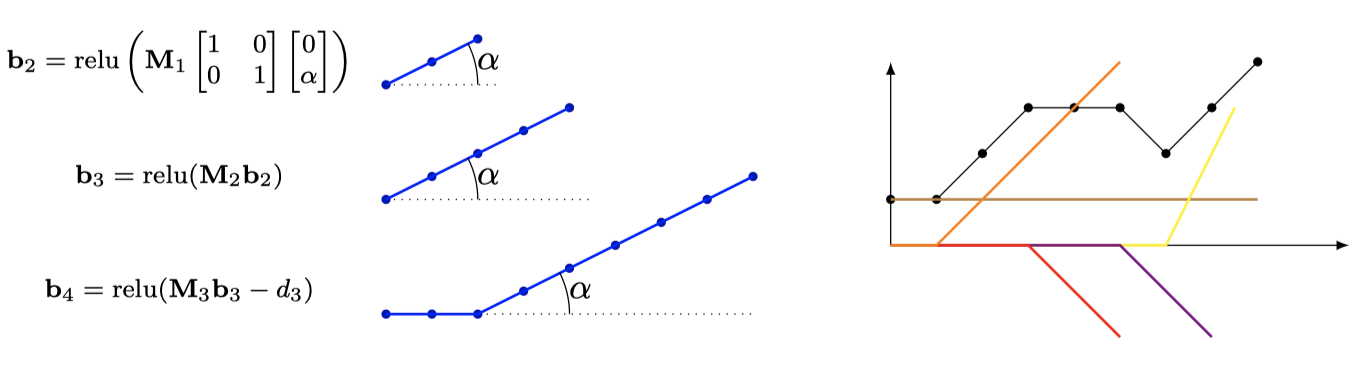
讨论:
noise2noise 和 DIP 的关系
生成模型