A secure authentication and data encryption protocol that allows AI agents, merchants and merchant vendors:
- ✅ Authenticate each other: verify the agent's identity and its relationship to the customer behind it
- ✅ Maintain rich customer data: reduce data losses and increase agents approval rate
- ✅ Improve user experience: create personalized, secure and frictionless checkout experience
- ✅ Prevent fraud: differentiates between legitimate agentic activity and fraud attempts
🎉 Read the announcement on Forter Blog
- JavaScript - Node.js >=18.0.0
- TypeScript - Node.js >=18.0.0
- Python - Python >=3.8
- More coming soon!
Trusted Agentic Commerce Protocol relies on:
- JWS+JWE Security: JWT signatures (JWS) wrapped in JSON Web Encryption (JWE) for both authentication and confidentiality
- RSA & EC Key Support: Compatible with RSA and Elliptic Curve (P-256/384/521) keys for signing and encryption
- JSON Web Key Sets (JWKS): Standard key distribution at
.well-known/jwks.jsonendpoints
# Generate RSA key pair
openssl genpkey -algorithm RSA -out private.pem -pkeyopt rsa_keygen_bits:2048
openssl rsa -in private.pem -pubout -out public.pem

# Extract values for JWKS publishing:
# Extract modulus (n) - base64url encoded (single line output)
openssl rsa -in public.pem -pubin -modulus -noout | \
  cut -d'=' -f2 | xxd -r -p | base64 | tr -d '=\n' | tr '/+' '_-'

# Generate key ID (kid) - SHA-256 hash of public key
openssl rsa -in public.pem -pubin -outform DER 2>/dev/null | \
openssl dgst -sha256 -binary | base64 | tr -d '=' | tr '/+' '_-'# Generate EC key pair (P-256 curve)
openssl ecparam -name prime256v1 -genkey -out private.pem
openssl ec -in private.pem -pubout -out public.pem
# Extract values for JWKS publishing:
# Extract x coordinate (base64url encoded)
openssl ec -in public.pem -pubin -text -noout 2>/dev/null | \
grep -A 3 'pub:' | tail -3 | tr -d ' \n:' | xxd -r -p | \
head -c 32 | base64 | tr -d '=' | tr '/+' '_-'
# Extract y coordinate (base64url encoded)
openssl ec -in public.pem -pubin -text -noout 2>/dev/null | \
grep -A 3 'pub:' | tail -3 | tr -d ' \n:' | xxd -r -p | \
tail -c 32 | base64 | tr -d '=' | tr '/+' '_-'
# Generate key ID (kid) - SHA-256 hash of public key
openssl ec -in public.pem -pubin -outform DER 2>/dev/null | \
openssl dgst -sha256 -binary | base64 | tr -d '=' | tr '/+' '_-'Publish your public keys at https://your-domain.com/.well-known/jwks.json:
For RSA keys:
{
  "keys": [
    {
      "kty": "RSA",
      "n": "<output from n extraction>",
      "e": "AQAB",
      "alg": "RS256",
      "kid": "<output from kid generation>"
    }
  ]
}
For EC keys (P-256):
{
  "keys": [
    {
      "kty": "EC",
      "crv": "P-256",
      "x": "<output from x extraction>",
      "y": "<output from y extraction>",
      "alg": "ES256",
      "kid": "<output from kid generation>"
    }
  ]
}Typically AI agent:
- Makes requests on behalf of users
- Signs JWTs to prove identity
- Encrypts sensitive user data for specific recipients
- Publishes public signing keys via JWKS
Typically Merchant and/or Merchant Vendor:
- Receives authenticated requests
- Verifies JWT signatures from senders
- Decrypts user data encrypted for them
- Publishes public encryption keys via JWKS
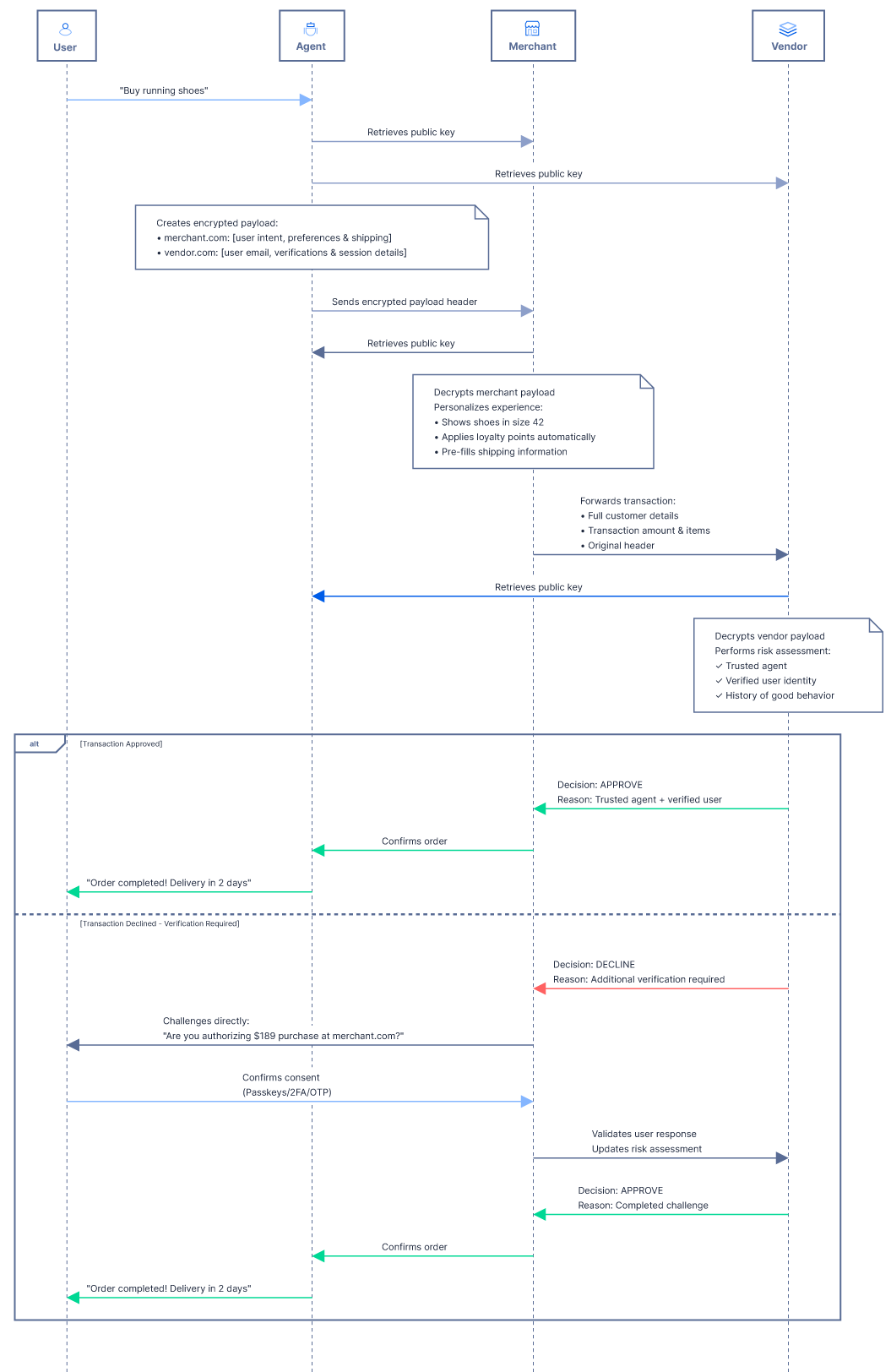
| Without the protocol | With the protocol | |
|---|---|---|
| Agent Developers | Your legitimate agent is blocked by aggressive merchant filters or fraudulent usage by other users, leading to failed tasks and frustrated users | Your agent is recognized and trusted by merchant sites, leading to near-100% success rates for login and checkout and higher user satisfaction |
| Merchants | You block all bot traffic to protect your site because you’re unsure what is good or bad, losing out on potential sales and the potential of agentic commerce | You can distinguish between trusted agents and bot threats, enabling you to process more sales and offer personalized experiences based on verified user data |
| Merchant vendors | You struggle to evaluate agent-driven transactions because you can’t distinguish legitimate agents from malicious bots, leading to missed revenue opportunities and strained merchant relationships | You receive verifiable identity and intent data from recognized agents, enabling precise risk assessments, fewer false declines, and stronger merchant trust in your services |
| End-users | Your personal assistant fails to book a flight because it can’t complete a login, gets hit with a CAPTCHA or is blocked as "suspicious" | Your agent acts as a true extension of yourself, recognized and accepted by merchants, with your data and preferences respected |
-
Key Management
- Store private keys securely
- Rotate keys regularly
- Never commit keys to version control
-
HTTPS Only
- Always use HTTPS in production
- Verify SSL certificates
-
JWT Validation
- Check JWT expiry
- Verify issuer claims
- Validate signing algorithm
MIT License