A modern, fast and extensible Hugo theme for personal websites and professional landing pages - with blog and portfolio support

- 🏎️ Fast, minimalistic code (no jQuery or other javascript frameworks)
- 🖼️ Bootstrap v5 (
v5.3.8) CSS framework with Scss customization - 📚 Multi-language (i18n) support with RTL (Right-to-Left) language support
- 🛠️ Custom content types (work experience, education, projects/work showcase, testimonials, blog)
- 🧰 Multiple shortcodes to customize your landing page in any way you want
- 🔎 Lightning fast search (powered by fuse.js)
- 💯 Perfect Lighthouse scores (Performance, Accessibility, SEO)
- 🌚 Automatic dark/light theme switching, with manual override
- 🖨️ Print-friendly CV template
- 🔧 Technical Skills showcase with visual skill bars and categories
- ⚡ Vercel-ready with Analytics & Speed Insights support
- 🖼️ Menus with icon support
- 🔗 Related posts - Automatically display related content based on tags
- 📤 Social sharing buttons - Built-in sharing for Twitter/X, LinkedIn, Facebook, and Email
- 📑 Table of Contents - Auto-generated, sticky TOC for blog posts
- 💬 Comments integration - Support for Disqus, Giscus, and Utterances
- ⏱️ Reading time display - Estimated reading time for blog posts
- 🏷️ Enhanced taxonomy support - Improved tags, categories, authors, and series display
The theme focuses on accessibility, high performance, and usability (it's very easy to get started). It's extendable by adding your own styles or content types, and it has a solid foundation on which to build.
Some of the best applications for the theme are for minimalistic websites, single-page applications, and personal portfolios. It has a contact form you can customize to your mail address without setting up a backend.
Tip
Do you like the theme? 🌟 Star the repo on GitHub to help make it more visible
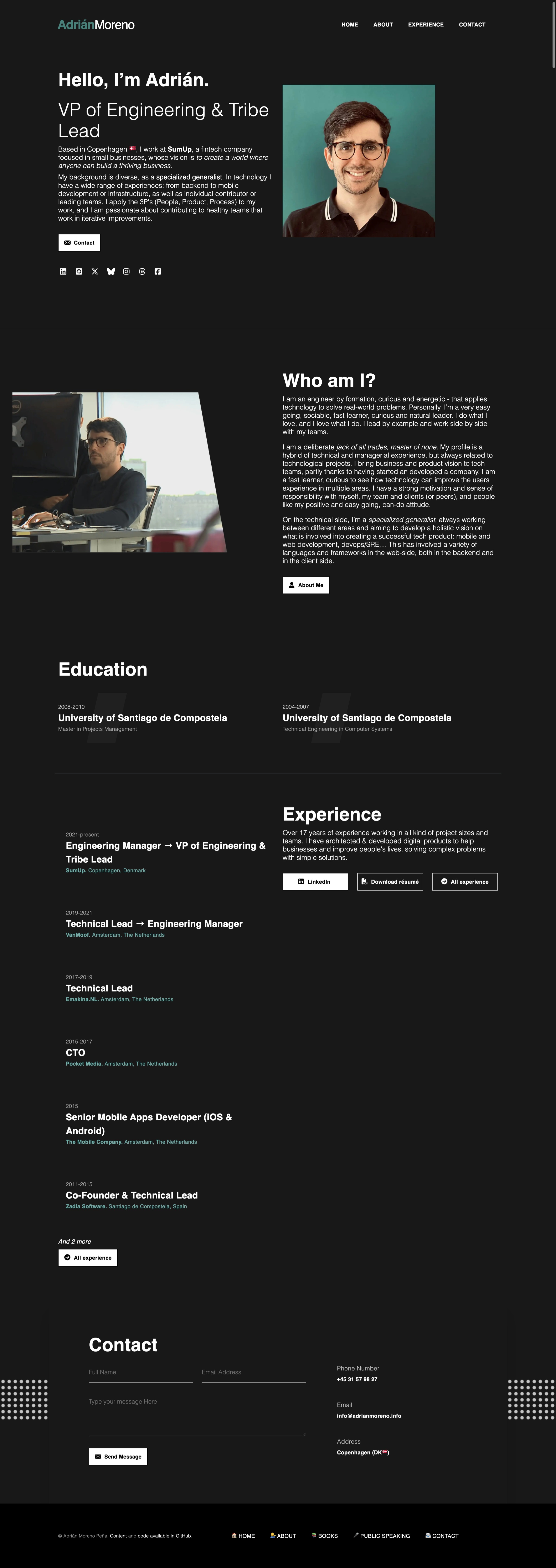
You can see it live at www.adrianmoreno.info (my personal website), as well as in these screenshots of the homepage, in the dark and light variations of the theme:

|
|
The dark color variation is selected automatically based on browser settings, and a color switcher is available in the footer and the mobile menu for visitors to override.
Other relevant repositories related to this theme are:
- adritian-theme-helper: npm package helper, used to bootstrap the theme. It helps initialize a site with the right content and configuration files.
- A full-featured site, my personal website in github too, so you can see how the theme can look real-life (including deployment scripts).
- A simpler demo site for the theme, adritian-demo (and its code), where the demo content comes from. Author page example: https://adritian-demo.vercel.app/authors/adrian-moreno-pena/.
- The same demo site, in a git submodules integration.
💡 For more inspiration, check this document's showcase section.
✨ This theme is entirely free and open source. We welcome your ideas, feedback, and contributions! If you find it useful, please give it a GitHub star to show your support.
This is a theme for the website generator Hugo. To use it, you must install Hugo by following the official guide.
We recommend installing the theme as a Hugo module (recommended, and explained below). This is the most powerful way to install the theme, will allow you to combine it with other modules, and is probably the easiest way to update across theme versions.
Another alternative is to use git submodules or to download the theme as a zip file and copy the files to your site*. But that will make your site "stuck in time" and more difficult to upgrade. This is not recommended or supported directly.
On the release files:
*from the versionv1.5.4the theme available as a zip file in the releases page contains thenode_modulesfolder, so you don't need to install it separately. This is a convenience for edge cases that might have problems installing the theme as a module or downloading many files.__
Note: Before proceeding, Ensure you have Go and Hugo installed and that you have created a new Hugo project. As a pre-requirement, you will need Hugo set up and running. You can follow the official guide for it.
The theme has been tested with Hugo version 0.136 (extended version). If you get errors regarding missing functionalities, check if you have the latest version of Hugo available.
Note: as mentioned, the theme supports both Hugo modules and git submodules. You should use Hugo modules to install the theme in the most maintainable way. If you prefer git submodules you can follow these older instructions or the next ones as help:
Step-by-step instructions to setup the theme as a hugo module
- Create a new Hugo site (this will create a new folder):
hugo new site <your website's name> - Enter the newly created folder:
cd <your website's name>/ - Initialize the Hugo Module system in your site if you haven't already:
hugo mod init github.com/username/your-site(you don't need to host your website on GitHub, you can add anything as a name) - Install the theme as a module:
hugo mod get -u github.com/zetxek/adritian-free-hugo-theme - Add the following to your
hugo.toml, to set the theme as active:
[module]
[[module.imports]]
path = "github.com/zetxek/adritian-free-hugo-theme"
- Prepare the
package.jsonfile:hugo mod npm pack - Install the dependencies:
npm install. This will include Bootstrap (needed for styling) and the helper script adritian-theme-helper. - Run the initial content downloader:
./node_modules/@zetxek/adritian-theme-helper/dist/scripts/download-content.js. This will download the demo content from the adritian-demo repository and copy it to your site, for a quick start (including translations, images, configuration and content)
The initial configuration allows you to have a base to edit and adapt to your site, and see the available functionalities.
Make sure to edit baseURL, title and description. You can edit the header links, as well as the languages to your needs.
After you have installed the npm packages and setup the initial contents, you can
- Start Hugo with
hugo server... - 🎉 The theme is alive on http://localhost:1313/
For next steps and guidance on where to customize your content, check the demo site. You can check the demo site help page for other installation methods (such as submodules or manual configuration).
The theme is extensible and customizable in multiple areas, and it can be tricky to figure out exactly what to edit. This is a guide (that is complemented by the demo site).

menu-language.mp4
The theme implements the internationalization (i18n) system by Hugo, to enable multilingual sites.
See the content in the i18n folder to edit the translations, and the configuration hugo.toml to define your active languages. The theme includes translations for:
- English (
en) - Spanish (
es) - French (
fr) - German (
de) - Dutch (
nl) - Danish (
da) - Italian (
it) - Portuguese (
pt) - Swedish (
sv) - Norwegian (
no) - Polish (
pl) - Arabic (
ar) - with full RTL support - Hebrew (
he) - with full RTL support
The theme includes comprehensive RTL (Right-to-Left) language support for Arabic and Hebrew. When a language is configured with languageDirection = 'rtl' in hugo.toml, the theme automatically applies RTL styling to all components including navigation, forms, tables, code blocks, blockquotes, breadcrumbs, and more. Images can be automatically mirrored using the rtl-mirror class, or prevented from mirroring with rtl-no-mirror.
The example site has 3 enabled languages by default (en, es, and fr). You can enable additional languages by adding them to your hugo.toml configuration, or disable the provided ones (by setting disabled to true on the languages you don't need).
Most of the content is expected to be translated via the content system of Hugo:
Note: The introduction of i18n support was done in the version v1.3.0 and it has breaking changes due to the way in which the content was managed. You can read about the upgrade path in CHANGELOG.md. In the version v1.7.0 the usage of Hugo's content management was expanded, to use less i18n strings and more file name/content directory based translations.
You can check the repository adritian-demo for a reference implementation, as well as the theme website (https://adritian-demo.vercel.app/), to get a visual guide on how to edit the content.
Following the initial setup instructions you will get a "ready-to-use" version of the site, with sample content for you to edit and customize.
The theme includes a dedicated Technical Skills showcase section that allows you to visually display your skills with progress bars and categorization:
- Create a
/skillssection in your site with customizable skill categories - Each skill can include name, proficiency level, years of experience, and description
- Visual skill bars automatically use your theme's primary color
- Full dark mode support with appropriate contrast
- Responsive design for all device sizes
- Accessible through navigation menu with multilingual support
To use this feature, create a skills/_index.md file with structured front matter for your skill categories and individual skills. The theme will automatically generate a visually appealing skills showcase page.
The theme auto-generates favicons and the web manifest from a single high-resolution source image.
By default it looks for assets/icons/favicon.png and uses Hugo image processing to produce
16×16, 32×32, 180×180, 192×192, and 512×512 assets. The favicon.ico file is generated
via npm run favicons (and is automatically run in the npm run serve and npm run build scripts).
You can override any individual path via params.favicons, or drop your own files in your site’s
static/ directory using the same paths. Uncommenting any of the override lines below disables
that generated asset and uses the static file at that path (or an absolute URL) instead. The
manifest is generated using your site title and the params.themeColor value (falling back to
#478079).
[params.favicons]
# Optional: provide a different source image for auto-generation
source = "icons/favicon.png"

# Optional: override any generated file with a static one
favicon = "/favicon.ico"
icon16 = "/icons/icon-16.png"
icon32 = "/icons/icon-32.png"
appleTouch = "/icons/apple-touch-icon.png"
icon192 = "/icons/icon-192.png"
icon512 = "/icons/icon-512.png"
manifest = "/site.webmanifest"
If you need custom names or colors in the manifest, place your own manifest file at the path above
(or update manifest to point to a custom location).
The theme leverages Hugo's embedded templates for Open Graph and Twitter cards, and adds JSON-LD
metadata and canonical URLs. Configure these in your site hugo.toml:
# Default Open Graph/Twitter image (used by Hugo embedded templates)
images = ["/img/og-img.png"]

[params.social]
twitter = "your_handle" # used for twitter:site (add @ is automatic)

[params.seo]
siteName = "Your site name"
siteDescription = "Short description of your site"
siteImage = "/img/og-img.png"

[params.seo.person]
name = "Your Name"
url = "https://example.com"
sameAs = ["https://github.com/youruser", "https://www.linkedin.com/in/youruser/"]

# Alternatively, use organization metadata
[params.seo.organization]
name = "Your Company"
url = "https://example.com"
logo = "/img/logo.png"
sameAs = ["https://www.linkedin.com/company/yourcompany"]
Blog posts can provide a featured image for JSON-LD with front matter:
[images]
featured_image = "/img/blog/my-post.png"
Notes:
- Open Graph/Twitter cards are rendered by Hugo's embedded templates (
opengraph.html,twitter_cards.html). - Canonical URLs are emitted automatically from each page permalink.
- JSON-LD includes
WebSitemetadata for all pages andBlogPostingfor blog posts.
The theme has multiple shortcodes available for use in the content, so you can customize your homepage (or any other page) as you want. You can read about them in the shortcodes page. Since version v1.7.0, this is the preferred way to set up your theme content and translations, as that's the most flexible system.
You can see the shortcodes in use in the demo site's pages, like
Search runs entirely in the browser using Fuse.js and a JSON index generated by Hugo. It is language-aware (for sites with translations) and works in subdirectory deployments by default.
- The search index is served from the language-specific
index.json(for example/es/index.json) - The search form uses
relLangURL, so language prefixes and subdirectories work out of the box - You can exclude any page from search with
search: falsein front matter
Read the full walkthrough (including how the index is built and how to customize it) in the demo blog: Search improvements: multilingual, reliable, and configurable.
(optional, if you want to use the contact form) edit the key contact in your homepage.yml file, to customize your mail address. Sign up in formspree to redirect mails to your own.
It can be rendered in any page via the contact-section shortcode.
Two layouts are available for the blog:
default(full-width for posts)sidebar(sidebar with recent posts and categories)
| Default Layout | Sidebar Layout |
|---|---|
 |
 |
| Full width posts | Posts with left sidebar |
| Clean, focused reading experience | Shows recent posts and categories |
| Maximizes content area | 25% width sidebar by default |
| Best for image-heavy posts | Helps with site navigation |

To use the blog, you can use the content type "blog", and render it in the URL /blog.
You can add a menu link to it in hugo.toml.
The posts will be markdown files stored in the content/blog folder.
The layout can be configured in the hugo.toml file, under the [params.blog] section:
[params.blog]
layout = "sidebar-right"     # options: default (no sidebar), sidebar, sidebar-right
sidebarWidth = "25"          # percentage width of the sidebar (when using sidebar layouts)
narrowContent = true         # if true, limits content width to 720px for better readability (default: true)
showCategories = true        # show categories in the sidebar
showRecentPosts = true       # show recent posts in the sidebar
recentPostCount = 5          # number of recent posts to display
listStyle = "summary"        # options: simple, summary
listLayout = "default"       # options: default, cards
Configuration options:
layout: Choose betweendefault(no sidebar),sidebar(left sidebar), orsidebar-right(right sidebar)sidebarWidth: Set the percentage width of the sidebar (e.g., "25" for 25%)narrowContent: When set totrue(default), limits the blog content width to 720px for optimal readability. Set tofalsefor full-width contentshowCategories: Display category links in the sidebarshowRecentPosts: Display recent posts in the sidebarrecentPostCount: Number of recent posts to show in the sidebarlistStyle: Choose betweensimple(title and date only) orsummary(includes excerpt)listLayout: Choose betweendefault(featured + list) orcards(stats header + card grid)
Related Posts
The theme automatically shows related posts at the end of each blog post based on shared tags and publish dates. This is powered by Hugo's built-in related content feature.
Table of Contents
Enable a table of contents for any blog post by adding these parameters to your post's frontmatter:
---
toc: true
tocSticky: true  # optional, makes TOC sticky on desktop
---
The TOC automatically generates from your post headings and only appears when the post has more than 400 words.
Social Sharing
Social sharing buttons are enabled by default for all blog posts. You can customize which platforms appear in your hugo.toml:
[params.sharing]
  enabled = true
  twitter = true
  linkedin = true
  facebook = true
  email = true
Comments
The theme supports popular comment systems. Configure in your hugo.toml:
[params.comments]
  enabled = true
  provider = "giscus"  # options: "disqus", "giscus", "utterances"

  # For Giscus (GitHub Discussions)
  [params.comments.giscus]
    repo = "username/repo"
    repoId = "your-repo-id"
    category = "General"
    categoryId = "your-category-id"

  # For Utterances (GitHub Issues)
  [params.comments.utterances]
    repo = "username/repo"
    issueTerm = "pathname"
    theme = "preferred-color-scheme"
For Disqus, set your disqusShortname in the site configuration.
Reading Time & Metadata
Blog posts automatically display:
- Estimated reading time
- Word count
- Publication date
- Last modified date (if
lastmodis set in frontmatter)
Authors & Series
You can group posts by author and series using taxonomies:
authors = ["Jane Doe"]
series = ["Hugo Basics"]
series_order = 2 # optional, to order posts inside the series
To customize author or series pages, create term content files:
hugo new authors/jane-doe/_index.mdhugo new series/hugo-basics/_index.md
Author pages support extra metadata when defined in the term content front matter:
---
title: "Jane Doe"
name: "Jane Doe"
role: "Staff Writer"
avatar: "/img/authors/jane.jpg"
bio: "Writes about Hugo and design systems."
links:
  - label: "Website"
    url: "https://example.com"
  - label: "GitHub"
    url: "https://github.com/janedoe"
---
Blog posts display author links automatically:
- If you use the
authorstaxonomy, the post header links to each author page. - As a fallback, plain
authororauthorsfront matter strings also render a link (to/authors/<slug>/).
The post meta section also labels Topics and Tags for clarity.
Performance note: the fallback author matching scans up to params.authorFallbackLimit regular pages (default: 500). For large sites, prefer the authors taxonomy.
This functionality and content is especially suited for personal professional sites, showcasing the work experience:

It can be used to render job experience, projects and/or clients. Each experience/project has a duration, job title, company name, location and description/excerpt as well as a longer text.
The experience is managed through a specific content type (see content/experience for an example).
You can use hugo new experience/experience-name.md (replacing experience-name by the name of the job experience).
This will create the content in the content/experience folder, following the experience archetype.
The following fields are used from the file's Front Matter: title, jobTitle, company, location, duration.
You can find a sample experience file content here:
---
date: 2007-12-01T00:00:00+01:00
draft: false
title: "Job #1"
jobTitle: "Junior Intern"
company: "Internet Affairs Inc. "
location: "Stavanger, Norway"
duration: "2022-2024"

---
### Fixing the world, one byte at a time

The beginning of a great career.
The experience can be displayed in several locations and different styles:
| Shortcode usage | Experience page | Single experience item | Print-friendly list |
|---|---|---|---|
 |
 |
 |
 |
| Experience list rendered via shortcode | Experience list in /experience | Experience item in in single page | Full-width print-friendly experience |
🔗 By using the shortcode experience-section: in a page (such as your homepage), with a limited number of experiences (controlled by the config parameter homepageExperienceCount in the file hugo.toml). The summary is displayed, as well as an introduction text and optional links |
🔗 Automatically, in the Experience page, in /experience, with a list of all experiences (no limit). The summary is displayed for each item, as well as a introduction text and optional links. |
🔗 Individual experience page (such as /experience/job-1), where all details are displayed, and links to the other descriptions are available to navigate. |
🔗 Using the shortcode experience-list you can generate a list of experience that is not interactive - good for print-friendly layouts. |
This theme is a version of the one found on my website adrianmoreno.info. If you run into trouble, you can check the code on my website for reference.
If you have improvements for the theme, you are very welcome to make a PR if you are able 💕. Otherwise - see below for how to get help (and maybe help others with the same problem).
The theme includes comprehensive E2E tests using Playwright to ensure all features work correctly.
# Run all tests
npm test

# Run E2E tests only
npm run test:e2e

# Run new features tests specifically
npm run test:e2e:new-features

# Run tests in UI mode (interactive)
npm run test:e2e:uiThe test suite includes 27 comprehensive tests for the new blog features:
- Related Posts functionality
- Social Sharing buttons (Twitter, LinkedIn, Facebook, Email)
- Table of Contents generation and navigation
- Enhanced reading metadata (reading time, word count, dates)
- Dark mode compatibility
- Responsive design
- Accessibility features
- Multilingual support
- Performance validation
See tests/README.md for detailed testing documentation.
- The site fails to build. Look for the last line of the stacktrace - if you find mentions to missing files, such as in
Error: error building site: TOCSS: failed to transform "/scss/adritian.scss" (text/x-scss): ".../.cache/hugo_cache/modules/filecache/modules/pkg/mod/github.com/zetxek/adritian-free-hugo-theme@v1.5.6/assets/scss/adritian.scss:1:1": File to import not found or unreadable: bootstrap/bootstrap.
Make sure that you have the dependencies installed. Check the troubleshooting steps in the following issue.
- The site renders in a weird-looking way, or you miss content. Check that the co