A high-performance, extensible node-based editor built with Rust and gpui. Designed for building visual programming tools, workflow editors, and graph-based UIs.
This project is in early stage (alpha), API may change
- 🧩 Plugin-based architecture
- 🧠 Interaction system (drag, pan, select, etc.)
- 🔄 Undo / Redo (Command pattern)
- 🔍 Viewport control (zoom & pan)
- 🖱️ Box selection & multi-select
- 🔗 Node / Port / Edge model
- 🎨 Custom node rendering system
- ⚡ Built with performance in mind (virtualization-ready)
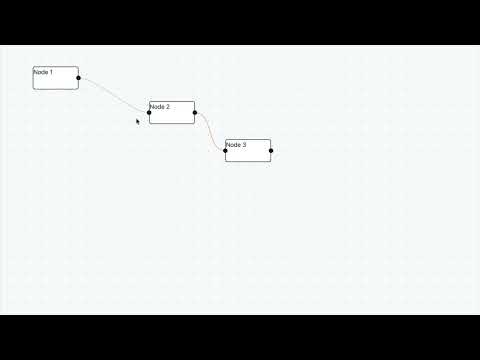
cargo add ferrum-flowThe system is designed with clear separation of concerns:
-
Graph Stores persistent data (nodes, edges, ports)
-
Viewport Handles zooming and panning
-
Plugin System Extends behavior (rendering, input handling, etc.)
-
Interaction System Manages ongoing user interactions (dragging, selecting, etc.)
-
Command System Enables undo/redo support
Plugins are the primary extension mechanism:
pub trait Plugin {
    fn name(&self) -> &'static str;

    fn setup(&mut self, ctx: &mut InitPluginContext);

    fn on_event(&mut self, event: &FlowEvent, ctx: &mut PluginContext) -> EventResult;

    fn render(&mut self, ctx: &mut RenderContext) -> Option<AnyElement>;

    fn priority(&self) -> i32 {
        0
    }

    fn render_layer(&self) -> RenderLayer {
        RenderLayer::Overlay
    }
}
Responsibilities
A plugin can:
- Handle input events
- Start interactions
- Render UI layers
- Modify graph state
Interactions represent ongoing user actions, such as:
- Node dragging
- Box selection
- Viewport panning
pub trait Interaction {
    fn on_mouse_move(&mut self, event: &MouseMoveEvent, ctx: &mut PluginContext) -> InteractionResult;

    fn on_mouse_up(&mut self, event: &MouseUpEvent, ctx: &mut PluginContext) -> InteractionResult;

    fn render(&self, ctx: &mut RenderContext) -> Option<AnyElement>;
}
Interaction Lifecycle
Start → Update → End / Replace
pub enum InteractionResult {
    Continue,
    End,
    Replace(Box<dyn Interaction>),
}Implements the Command Pattern:
pub trait Command {
    fn execute(&mut self, ctx: &mut CommandContext);
    fn undo(&mut self, ctx: &mut CommandContext);
}
Built-in Features
- Undo / Redo stacks
- Composite commands
- Easy integration via PluginContext
ctx.execute_command(MyCommand { ... });Rendering is fully customizable via a registry:
pub trait NodeRenderer {
    fn render(&self, node: &Node, ctx: &mut RenderContext) -> AnyElement;

    // custom render port UI
    fn port_render(&self, node: &Node, port: &Port, ctx: &mut RenderContext) -> Option<AnyElement> {
        // ... default implement
    }

    // computing the position of port relative to node
    fn port_offset(&self, node: &Node, port: &Port, graph: &Graph) -> Point<Pixels> {
        // ... default implement
    }
}
Render example:
div()
    .absolute()
    .left(x)
    .top(y)
    .w(width)
    .h(height)
.bg(white())pub struct Node {
pub id: NodeId,
pub node_type: String,
pub x: Pixels,
pub y: Pixels,
pub size: Size<Pixels>,
pub inputs: Vec<PortId>,
pub outputs: Vec<PortId>,
pub data: serde_json::Value,
}🏗️ Creating Nodes (Builder API)
graph.create_node("math.add")
    .position(100.0, 100.0)
    .input()
    .output()
.build(&mut graph);Designed to scale to large graphs:
- Viewport-based rendering (virtualization)
- Layered rendering system
- Interaction-aware rendering (degraded mode during drag)
- Ready for spatial indexing
- Separation of data and interaction
- Plugins over hardcoded behavior
- Explicit state transitions
- Performance-first rendering
- Composable architecture
- Edge rendering improvements
- Connection (drag-to-connect)
- Spatial indexing (Quadtree/Grid)
- Interaction priority & conflict resolution
- Collaboration support
Contributions are welcome!
Feel free to open issues or PRs for:
- New plugins
- Performance improvements
- API design suggestions
Apache2.0