Picking out a single voice in a noisy crowd is hard for everyone and can be nearly impossible for people with hearing loss. Conventional hearing aids amplify all sounds, providing little help when competing conversations move around a listener. Brain-controlled augmented hearing offers a different path: read neural signals to understand which talker the listener cares about, then selectively amplify that voice.
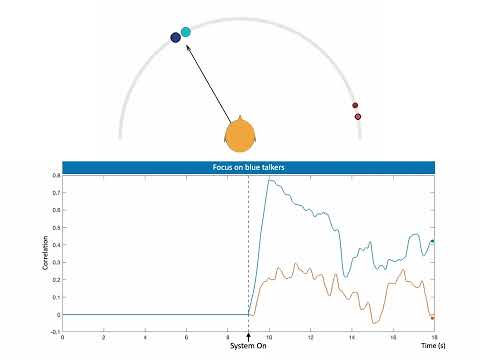
This project brings that vision closer to reality by marrying auditory attention decoding (AAD) with spatially aware speech separation. We record invasive EEG (iEEG) from three neurosurgical participants as they follow one of two moving speakers in a noisy environment. A binaural, speaker-independent separation model unmixed the speech mixture while preserving spatial cues and estimating talker trajectories, which in turn support more accurate neural decoding. Together, these components deliver a system that tracks conversations, maintains natural spatial perception, and improves both intelligibility and listening comfort under challenging acoustic conditions—pointing to technology that can support people with hearing difficulties and augment the hearing of those with typical hearing alike.
🏆 This work received Third Place at the 2024 International BCI Competition.
This repository provides code and resources for the system evaluated in the project. It contains two main technical components:
- Binaural Speech Separation 🎯 – separates the speech streams of moving talkers while preserving their spatial locations.
- Auditory Attention Decoding (AAD) 🧭 – infers which talker a listener attends to based on recorded neural activity.

This pipeline covers dataset preparation, model training, and inference resources for handling moving-speaker mixtures.
- Python 3.9.16 (tested)
- Packages listed in
requirements.txt
Install dependencies:
pip install -r requirements.txt- Google Resonance Audio SDK for spatialization. Supporting scripts are available here.
- Pre-generated moving speaker audio to skip offline rendering.
- DEMAND dataset for additive background noise.
Train the separation, enhancement, and localization models sequentially.
Prepare training data and fit the separation network:
python create_separation_dataset.py
python train_separation_model.py \
  --training-file-path /path/to/train.json \
  --validation-file-path /path/to/val.json \
--checkpoint-path /path/to/checkpointsGenerate enhancement training examples with the trained separator, then launch training:
python train_enhancement_model.py \
  --training-file-path /path/to/train.json \
  --validation-file-path /path/to/val.json \
--checkpoint-path /path/to/checkpointsUse the enhanced outputs to form localization training data, then fit the trajectory predictor:
python train_localization_model.py \
  --training-file-path /path/to/train.json \
  --validation-file-path /path/to/val.json \
--checkpoint-path /path/to/checkpointsThis section documents scripts for CCA-based AAD analysis.
auditory_attention_decoder/analysis_scripts/train_aad_decoder.m: trains CCA models that link neural signals to the attended stimulus.auditory_attention_decoder/analysis_scripts/test_aad_decoder.m: evaluates CCA performance across window sizes and reports correlations with attended versus unattended stimuli.
The CCA implementation builds on the NoiseTools package by de Cheveigné et al.:
de Cheveigné, A., Wong, DDE., Di Liberto, GM., Hjortkjaer, J., Slaney, M., & Lalor, E. (2018). Decoding the auditory brain with canonical correlation analysis. NeuroImage, 172, 206–216. https://doi.org/10.1016/j.neuroimage.2018.01.033
Click the thumbnail below to watch the end-to-end system in action:
Choudhari, V., et al. (2024). Brain-controlled augmented hearing for spatially moving conversations in multi-talker environments. Advanced Science, 2401379. https://doi.org/10.1002/advs.202401379